Review · NAPLES
Naples: The Spanish Quarters, Street Art and Local Market
Naples comes into focus on foot, especially when a guide connects the grand opera house and royal square with laundry-hung lanes, football shrines, and market stalls. I like the route’s sharp change of mood, from polished Piazza Plebiscito to the raw character of the Spanish Quarters. I also like the stop at Pignasecca market, where a small food tasting gives you more than another view from a coach window.
The main thing to consider is the pace and setting. This is a compact two-hour walk through narrow streets, stairs, crowds, and uneven city pavement, and the food tasting is limited to one sweet or savory item. One Italian-language review found little added value over walking alone, so the tour works best if you want local context, not just a route map.
Key points at a glance
- Starts at Gran Caffè Gambrinus: Meet outside Naples’ famous literary café, close to the San Carlo Theatre, Galleria Umberto, and Piazza Plebiscito.
- Spanish Quarters street art: Walk through steep lanes and stairways decorated with laundry, murals, and neighborhood shrines.
- Maradona’s Naples: See the famous murals honoring the football champion and local idol.
- Pignasecca food stop: Explore a working market and taste one typical Neapolitan sweet or savory street food.
- Ends on Spaccanapoli: Finish near Gesù Nuovo, the Immaculate Conception obelisk, and Santa Chiara.
- Good value at $35: The price is reasonable if you value explanation, local orientation, and a small tasting during a short visit.
From Gran Caffè Gambrinus to monumental Naples
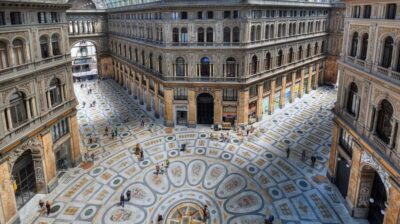
Your meeting point is outside Gran Caffè Gambrinus, an elegant and well-known literary café in the heart of the city. It is a useful starting place because Naples looks unusually formal here. The route brings together the San Carlo Theatre, Galleria Umberto, Piazza Plebiscito, and the Royal Palace.
The San Carlo Theatre gives you a glimpse of Naples as a major center of music and performance. The Galleria Umberto offers a grand covered arcade, while Piazza Plebiscito opens into one of the city’s broadest public spaces. The Royal Palace frames the square and adds a royal layer before the walk turns toward the tighter streets.
I like this opening because it helps you read Naples through contrast. The city is not just old lanes and noisy markets. It also has grand civic spaces, a major opera house, royal architecture, and polished nineteenth-century interiors.
The drawback is that this part of the walk is more about orientation than extended sightseeing. You are not given a long visit inside the San Carlo Theatre, Galleria Umberto, or Royal Palace. If you want detailed interior tours, you will need separate tickets and more time.
More Local and Farmers Market Tours in Italy
- Cooking Class and Lunch at a Tuscan Farmhouse with Local Market Tour from Florence
★ 5.0 · 4,831 reviews - Palermo: Street Food and Local Market Tasting Tour
★ 4.9 · 540 reviews - Pasta and Tiramisu Cooking Class with optional Local Market Tour
★ 5.0 · 515 reviews
Entering the Spanish Quarters by steep lanes and stairs
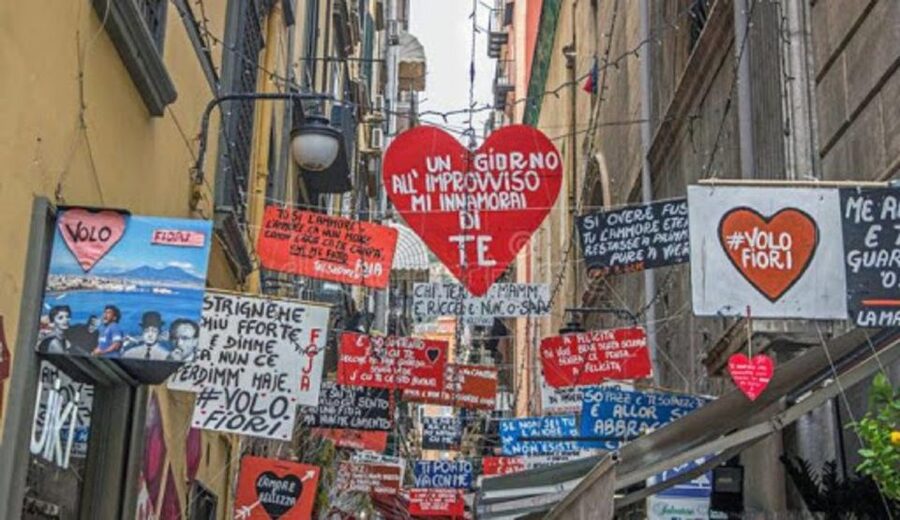
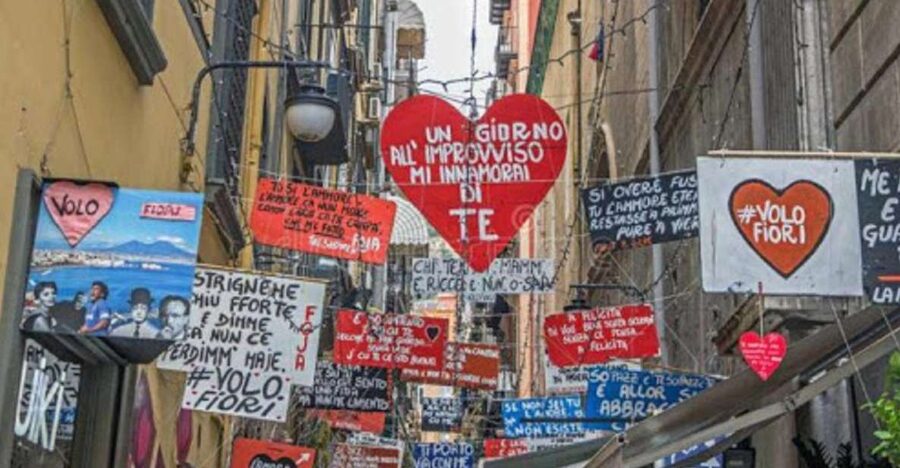
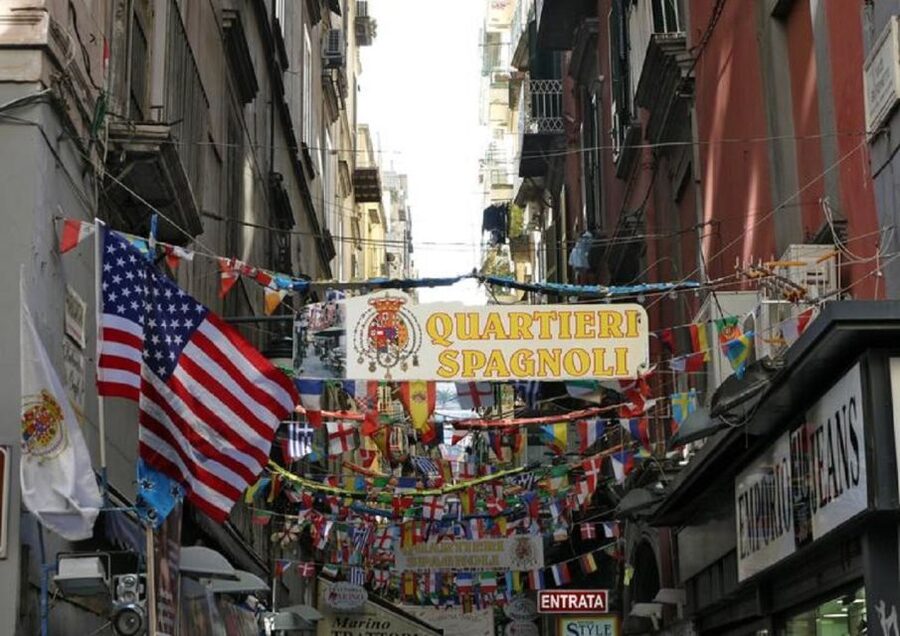
The walk then enters the Quartieri Spagnoli, or Spanish Quarters. This is one of Naples’ most characteristic areas, with a dense grid of narrow lanes climbing the hill. The streets can feel close and busy, but that tight layout is also what gives the neighborhood its strong identity.
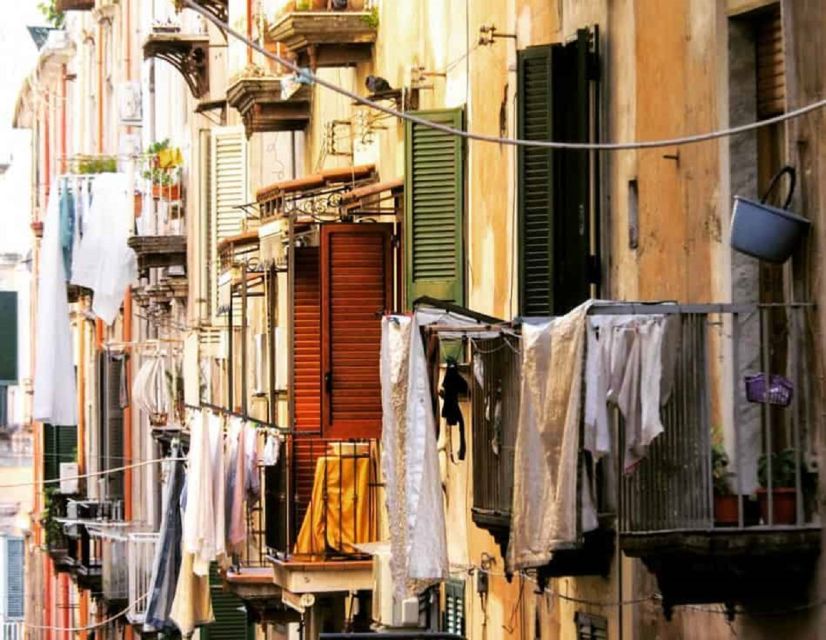
Look upward as you walk. Balconies are decorated with hanging laundry, small objects, and household life spilling into the street. The view above your head matters as much as what is at eye level. Naples often feels like a city lived in publicly, and this part of the walk makes that clear.
Your guide’s role matters here. A map can show you the basic grid, but it cannot explain why the alleys turn as they do, how the neighborhood is organized, or which details are worth noticing. The route is short enough to keep moving, yet long enough for you to see the contrast between monumental Naples and residential Naples.
This is not a polished sightseeing district. You should expect a real neighborhood rather than a tidy open-air museum. That means noise, people, laundry, parked scooters, and narrow passages. It also means you get a more direct look at everyday Naples.
Maradona murals and the football heart of Naples
Football is not a side note in Naples. The tour takes you through places connected with Diego Maradona, whose image has become part of the city’s visual identity. The most famous murals honor him as both champion and local idol.
For many people, this will be the most memorable part of the Spanish Quarters. The mural is not simply a piece of street decoration. It reflects local pride, memory, and the way sports can shape a city’s identity. Even if you are not a football fan, the enthusiasm around Maradona helps explain something important about Naples.
Your guide can give this stop meaning beyond taking a photograph. Names such as Gianluca, Giorgia, Rosa, and Sara have led this walk, and the strongest guide reports describe a warm, humorous style with useful background on Naples, philosophy, and history. Gianluca, in particular, has been praised for his passion for the city and for offering practical suggestions for the rest of a Naples visit.
That personal guidance is where the $35 price earns its keep. You are not paying for a long list of admission tickets. You are paying for a local voice that can connect a mural, a street, and a city attitude in a short amount of time.
Pignasecca market, where Naples gets edible
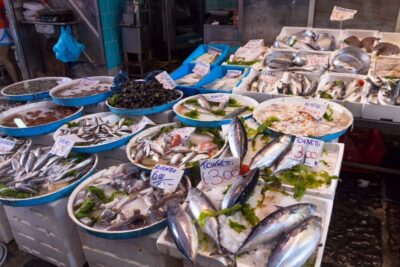
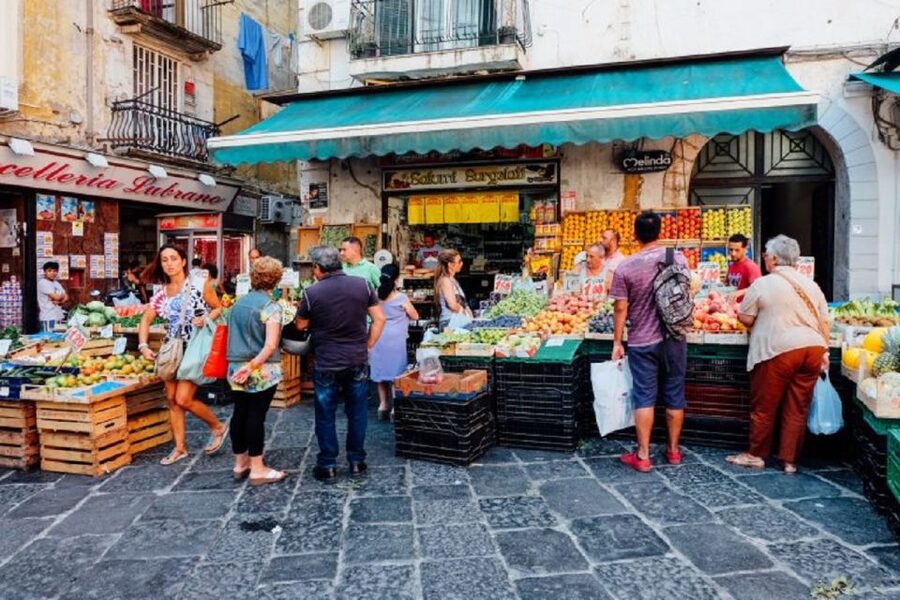
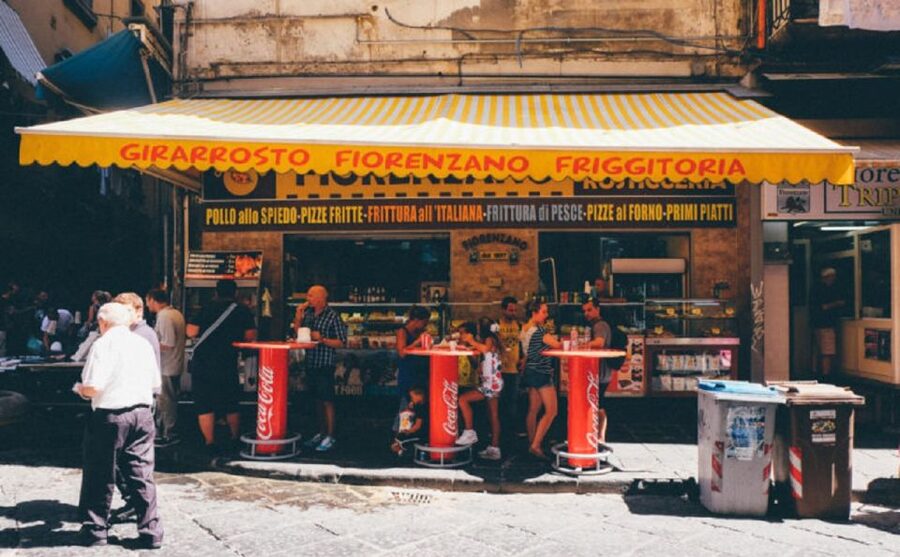
Pignasecca is the food center of the walk. This local market is lined with food and clothing shops, and the experience is based as much on your senses as on formal sightseeing. You will see produce, food displays, shopfronts, and the daily trade that gives the area its working character.
The market is a good place to pause because it changes the focus from monuments to ordinary life. Smells carry through the lanes. Displays compete for your attention. The best way to approach it is to let the guide point out the typical foods and explain what you are seeing rather than trying to decode every stall on your own.
The tour includes one food tasting, either sweet or savory. That is useful, but keep your expectations in proportion. This is not a full food tour, and you should not plan to replace lunch with it. Think of the tasting as a small introduction to Neapolitan street food, with plenty of room to buy more on your own afterward.
The market may be the least comfortable part for anyone who dislikes crowded streets or strong food smells. It is also one of the most authentic stops. I would rather have one well-placed taste in a real market than a large, generic snack handed out in a tourist setting.
Same city, another market:
- Rome: Colosseum, Roman Forum & Trajan’s Market Exterior Tour
★ 4.3 · 2,038 reviews - Taste of Testaccio: Special 15 Year Anniversary Edition
★ 5.0 · 1,658 reviews - Small Group Cooking Class & Market Food Tour in Florence
★ 5.0 · 1,574 reviews - Bologna Food & Market Tour with 6 Tastings, Pasta, Wines & More
★ 5.0 · 1,328 reviews
Finishing on Spaccanapoli
The walk finishes on Spaccanapoli, the straight and animated route cutting through the old town. Its name means Naples splitter, a simple description of the way the street appears to divide the historic center when viewed from above.
This final stretch gives the walk a strong ending. You pass the Church of Gesù Nuovo, the Obelisk of the Immaculate Conception, and the Basilica of Santa Chiara. Each adds a different note to the old center, from the unusual stone facade of Gesù Nuovo to the open public presence of the obelisk and the calm religious setting of Santa Chiara.
The route also leaves you in a useful part of Naples for continued exploring. You can treat the tour as a first look and then return to whichever area caught your attention. Since the walk covers several districts rather than staying beside one landmark, it helps you decide where to spend the rest of your day.
Do not expect a long interior visit at every church. The value is in the sequence and the guide’s explanation. You see how the old center links to the Spanish Quarters and market district, rather than viewing each monument as an isolated stop.
What the guide adds to a short walk
Two hours passes quickly in Naples. A strong guide keeps the route from becoming a blur of names and buildings. The best experience here depends on clear storytelling, a good pace, and practical advice.
Gianluca has been singled out for humor, charm, and passion for Naples, along with helpful suggestions for getting around and finding pizza afterward. Giorgia has been described as professional and engaging with a small group, while Rosa’s approach has been praised for combining simple explanations with memorable local stories. Sara has also been noted for making the walk interesting and enjoyable.
Those details matter because the route itself is easy to copy. You can walk from Gambrinus to the Spanish Quarters, Pignasecca, and Spaccanapoli with a phone map. The guide’s value comes from helping you notice why the streets look the way they do and how the places fit together.
There is one fair criticism to keep in mind. If you already know Naples well, or if you enjoy researching every stop before you arrive, you may find the tour too basic. One Italian-language assessment felt it added little beyond walking alone. That is a legitimate concern, especially for independent visitors who prefer their own pace.
Group size, headsets, and the practical pace
The activity lasts two hours and is offered in Italian or English. Headsets are provided when the group reaches six or more participants, which helps when the streets are noisy or the guide needs to speak while the group is spread along a narrow lane.
The supplied information does not set a fixed group size. One experience with four people was described as particularly easy for hearing the guide and taking in the stories. A smaller group usually makes it simpler to ask questions, but you should not assume every departure will be that small.
The route takes place rain or shine. Naples’ narrow streets can be slippery or crowded in poor weather, so wear shoes you can walk in for two hours and bring weather protection when needed. The tour includes streets, lanes, and stairs, so it is not a suitable choice if you are looking for a completely flat or indoor activity.
Meeting outside Gran Caffè Gambrinus makes the beginning easy to identify, but arrive with enough time to find the café and guide. A late arrival could be awkward once the group turns into the smaller streets.
Is $35 a fair price for two hours?
At $35 per person, this is a midrange short walking tour. The price includes the guide, a food tasting, and headsets for groups of six or more. It does not include entry to the San Carlo Theatre, the Royal Palace, or the churches.
The value is strongest for a first visit. You get a quick city orientation, a look at several key districts, and a taste of local food without giving up half a day. The tour also helps you understand how Naples’ grand center, Spanish Quarters, market streets, and old town relate to one another.
The value is weaker if your main goal is eating. One tasting cannot compete with a dedicated food walk. It is also weaker if you want long visits inside monuments or museums, since the route focuses on seeing and explaining places from the street.
Free cancellation up to 24 hours before the start and the option to reserve now and pay later reduce the risk of fitting it into a changing schedule. Those booking terms are useful, but the main reason to choose this tour should be the guided neighborhood context.
Who should choose this Naples walk?
I would recommend it to you if you are visiting Naples for the first time and want a fast introduction to the city’s different personalities. It suits people who enjoy street life, local stories, public art, markets, and architecture in one route.
It is also a good fit if you want help getting your bearings before exploring independently. The advice offered by guides such as Gianluca can be useful after the walk, especially when you are deciding where to eat or which old-town streets to revisit.
Families with older children may like the changing scenery. The Maradona murals and market stop are easier to connect with than a long lecture inside a museum. Still, the narrow lanes and stairs may be tiring for anyone who has trouble with uneven walking.
You may want a different experience if you prefer a slow food tour, a detailed art tour, or a private visit built around your own interests. Two hours gives you range, not depth. That is the bargain and the limit.
Should you book the Spanish Quarters and market tour?
Book this walk if you want a lively first read of Naples, especially one that combines famous monuments with neighborhood streets and a small taste of market food. Its best moments are the sharp shift into the Spanish Quarters, the Maradona mural, Pignasecca, and the final stretch along Spaccanapoli.
Skip it if you already know these districts well or if you would rather spend $35 on a longer food experience. For most first-time visitors, though, the short length and broad route make it a sensible introduction. You will leave with a better sense of where you are, what Naples values, and which streets deserve a closer look on your own.
FAQ
Where does the tour meet?
The meeting point is outside Gran Caffè Gambrinus in Naples.
How long does the walking tour last?
The tour lasts two hours.
What languages are available?
The live guide is available in Italian and English.
Is food included?
Yes. The tour includes one typical street food tasting, which may be sweet or savory.
Are headsets provided?
Headsets are provided when the group has six or more participants.
What places does the tour visit?
The route includes the monumental area around the San Carlo Theatre, Galleria Umberto, Piazza Plebiscito, and the Royal Palace. It then continues through the Spanish Quarters and Pignasecca market before finishing on Spaccanapoli near Gesù Nuovo, the Immaculate Conception obelisk, and Santa Chiara.
Does the tour run in bad weather?
Yes. The tour takes place rain or shine.
Can I cancel for a refund?
You can cancel up to 24 hours in advance for a full refund. You can also reserve now and pay later.
More street art walks around Italy
- The Spanish Quarters, Street Art and Local Market Tour in Naples
★ 5.0 · 23 reviews - Phnom Penh’s Morning Market and Street Art Tour by Tuk tuk
★ 5.0 · 128 reviews - Tbilisi: Street Art & Dezerter Bazaar Tour w/ Tastings
★ 4.8 · 30 reviews - Cancun: 3-Hour Food Tour, Visit to the Market & Street Art
★ 4.8 · 8 reviews
New market tours around Italy
- Taormina: Sicilian Cooking Class & Market Tour★ 4.9 · 212 reviews
- Florence: Markets and Food Tasting Tour★ 5.0 · 2 reviews
- Taormina: Sicilian Cooking Class w/ a Visit to Local Market★ 4.9 · 76 reviews
- From Taormina: Syracuse Tour with lunch in Food Market★ 4.9 · 12 reviews
- Syracuse: Traditional Cooking Class & Ancient Market Visit★ 4.9 · 72 reviews
- Spoleto: Market Tour and Meal at a Local’s Home★ 5.0 · 2 reviews
- Sorrento: Markets and Cooking Class at a Cesarina’s Home★ 3.7 · 3 reviews
- Taormina Half-Day Sicilian Cooking Class & Market Tour★ 5.0 · 82 reviews
Naples Market Tours, side by side.
Naples Street Food Experience with local guide – Small Group Tour
Read our review →
The Unfiltered Street Food & Market Tour of Naples (by Streaty)
Read our review →