
Review · TBILISI
Tbilisi:Mtskheta,Jvari,Bazaar,wine tasting,Chronicles of Georgia
Jvari Monastery gives this half-day trip its first big reward: a hilltop view over Mtskheta and the meeting point of two rivers. From there, you move through Georgia’s old religious center, taste local wine and sweets, then finish at the huge Chronicles of Georgia monument above Tbilisi Sea.
I like the low price and the sensible five-hour length. I also like the mix of ancient churches, local food and wine, and a modern monument that many short city tours skip. Guides such as Freddie, Tanu, George, and Toko are often praised for mixing history with humor, music, and help with group photos.
The tradeoff is pace. You cover several places in one morning, and your free time in Mtskheta is limited. If you want a quiet, slow visit inside every church or a long meal, book a private outing instead.
What makes this half-day trip useful
- Jvari’s hilltop setting: See Mtskheta, the Mtkvari River, and the Aragvi River from one memorable viewpoint.
- Two important churches: Visit Jvari Monastery and Svetitskhoveli Cathedral, both tied closely to Georgia’s religious and political past.
- Wine and local sweets: Depending on the option you choose, sample Georgian wine, churchkhela, and sweets during your time in Mtskheta.
- A modern surprise: The Chronicles of Georgia uses giant carved pillars to tell stories of kings, faith, and national identity.
- Easy central meeting point: Begin and end at Rose Revolution Square, close to Rustaveli metro station.
- Strong guide-led experience: Freddie, Tanu, George, Nika, and Toko are among the guides named in the feedback, with a style that ranges from lively and musical to calm and informative.
Why the $20 price works
At $20 per person, this is priced for people who want to see more than Tbilisi without spending a full day or hiring a private car. The price includes an air-conditioned vehicle and a guide. The basic option may not include every tasting, so check which version you select if wine or sweets are a main reason for booking.
I see the value in the transport alone. Jvari and Mtskheta are close to Tbilisi, but they are not convenient walking destinations. You could arrange a taxi or drive yourself, but then you would need to manage the route, parking, timing, and the background of each site. Here, the driver handles the roads and the guide connects the churches to Georgian history.
The trip is also efficient. You leave around 9:00 am and return around 2:00 pm. That leaves much of the afternoon for Tbilisi’s old town, a museum, a meal, or a second activity. If your visit is short, this matters.
The catch is that low-cost group tours make their money through shared transport and a fixed schedule. The group can reach as many as 50 people. That is a large possible group, even though some departures may be smaller. You should expect a planned morning rather than a personal tour built around your interests.
More market tours around the world:
- Bangkok: Damnoen Saduak Market and Maeklong Railway Market
★ 4.5 · 26,723 reviews - The Old Siam: Damnoen Saduak and Maeklong Railway Market
★ 4.5 · 10,992 reviews - Dubai: Old Town, Creek, Museums, Souks, & Street Food Tour
★ 4.8 · 10,816 reviews
Meeting at Rose Revolution Square
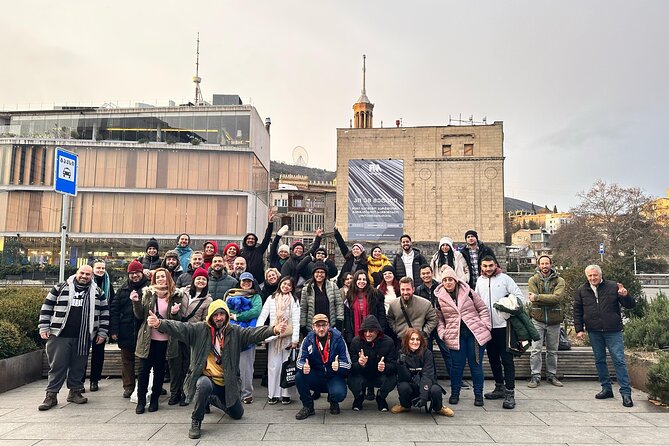
The main meeting point is in front of the Bicycle Monument near the Radisson Blu Iveria at Rose Revolution Square. It is about 50 meters from Rustaveli metro station, which makes it one of the easier central meeting points in Tbilisi.
The stated meeting time is 8:45 am, with departure around 9:00 am. Look for the tour leader wearing a red scarf. Arrive early. Tbilisi traffic can be slow, and a group vehicle cannot wait indefinitely for late arrivals.
There is a special arrangement for groups of more than four people. The information says the group will be picked up from its hotel at 8:15 am and taken toward the old capital. Since the standard meeting details still point to Rose Revolution Square, confirm the exact pickup instructions after booking if you are traveling as a larger group.
The tour returns to the original meeting point. That is useful because you can leave luggage or plan an afternoon from a known central location. Hotel drop-off is not part of the standard service.
Jvari Monastery and the first great view
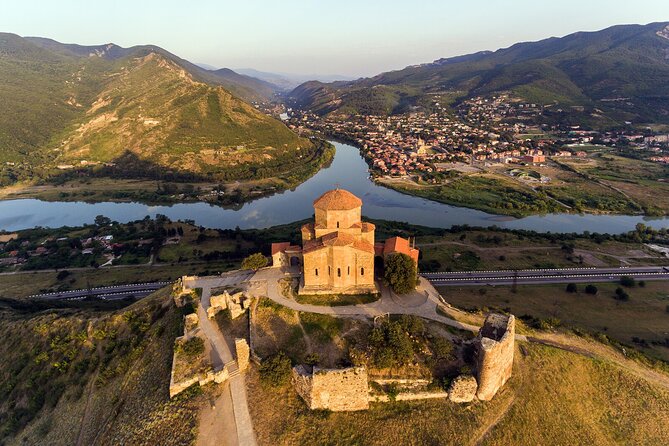
After roughly 30 minutes on the road, you reach Jvari Monastery. Its name means Monastery of the Cross, and the sixth-century Georgian Orthodox site is part of the UNESCO-listed monuments of Mtskheta.
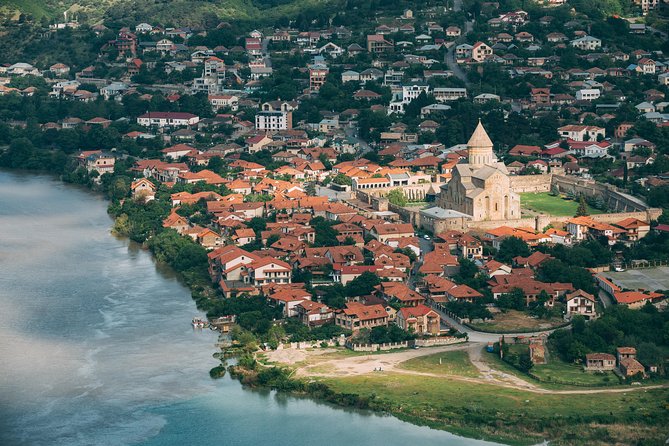
The setting is the real opening act. Jvari sits on a rocky mountaintop above the point where the Mtkvari and Aragvi rivers meet. Below, Mtskheta spreads across the valley. This is the kind of place where the view helps you understand the geography before the guide explains the politics and faith connected to it.
You have about 30 minutes here. That is enough for the main exterior view, photographs, and a look around the monastery. It is not a long, reflective visit. If you want to study every architectural detail, you may find the stop short, but the compact timing keeps the morning moving.
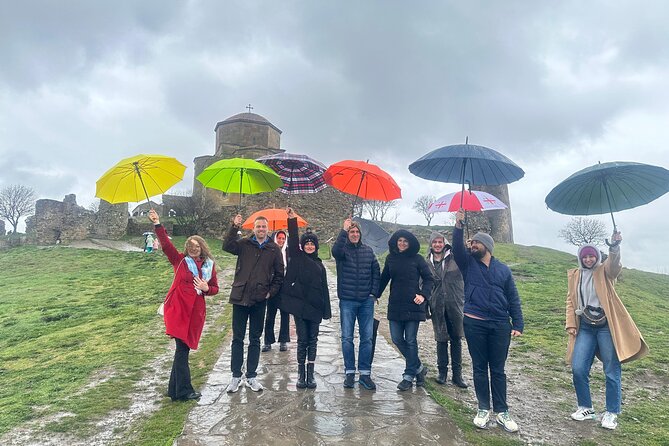
Bring sensible shoes and a layer in cooler weather. The stop is exposed, and one account describes a winter departure with snow in Tbilisi. The same trip still worked well as a photo and history stop, but the hilltop can feel colder and windier than central Tbilisi.
Listen closely during the drive and at the site. The value of Jvari is not only the church itself. It is the combination of a sixth-century religious building, a former capital below, and a river junction that makes the history easier to picture.
Mtskheta and Svetitskhoveli Cathedral
From Jvari, the route continues to Mtskheta, one of Georgia’s oldest cities and the former capital of the early Georgian Kingdom of Iberia. It served as a political center from the third century BC to the fifth century AD, then continued as a coronation and burial place for many Georgian kings.
The main stop is Svetitskhoveli Cathedral, currently the second-largest church building in Georgia after Tbilisi’s Holy Trinity Cathedral. It is one of the country’s most important Georgian Orthodox churches and is traditionally associated with the burial place of Christ’s mantle.
Your total time in Mtskheta is about two hours, with around one hour of free time for shopping, wine tasting, a snack, or a boat trip. The exact balance depends on the guide and the day’s conditions. You should expect an explanation of the cathedral and then a chance to explore at your own pace.
This is the most flexible part of the morning, but one hour goes quickly. You can look around the cathedral area, buy a local product, sample wine if that option is included, and take photographs. You probably cannot do all of those things slowly. Decide before arrival what matters most.
I would use the time in this order: first see the cathedral with the guide, then set aside a few minutes for the market or tasting, and only then consider an optional boat trip. If you stop for a long meal, you may lose the chance to browse.
Mtskheta is also where the cultural side of the tour feels most immediate. Jvari gives you the broad view and the old stone setting. Mtskheta gives you a living town with religious importance, local food, and small purchases. Churchkhela and sweets may be included if you select the relevant tasting option.
Same city, another market:
- Bangkok: Train Market & Floating Market with Boat Ride
★ 4.7 · 9,547 reviews - Dubai: Old Town, Souks, Street Food, Guided Tour & Abra Ride
★ 4.9 · 7,170 reviews - From Bangkok: Ayutthaya & Ayothaya Floating Market Day Trip
★ 4.7 · 6,084 reviews - Dubai: Frame Tickets, Creek, Souks & Blue Mosque Guided Tour
★ 4.8 · 5,980 reviews
Wine, churchkhela, and the limits of free time
The tasting element adds something practical to the church visit. Georgian wine is not treated as an abstract subject in a lecture. You get a chance to taste it, and the same applies to churchkhela and sweets when those options are selected.
The tasting is not a full winery visit. The provided schedule places it within the free time in Mtskheta. That means it works best as a short introduction, not as a serious wine-focused excursion. If your main goal is vineyard visits, cellar tours, or several hours of tasting, this is not the right format.
For most people, I like the balance. You get a local flavor without giving up the main historic stops. One guide-led account describes the wine tasting as fun, and another points to the combination of wine and sweets as a highlight of the morning.
Check your booking choice carefully. Wine tasting, churchkela tasting, and sweets tasting are listed as included only if the selected option contains them. Do not assume every $20 booking has the same extras.
The Chronicles of Georgia: giant stone and broad views
The final major stop is the Chronicles of Georgia, a striking monument above Tbilisi Sea. Designed by Zurab Tsereteli in 1985, it uses stone pillars about 30 meters tall, carved with scenes connected to Georgian history, rulers, and religious figures.
This stop changes the mood. Jvari and Svetitskhoveli are old religious sites with centuries of worship behind them. The Chronicles of Georgia is a large modern work that looks ancient at first glance but belongs to the late twentieth century. That contrast gives the tour a useful second half.
You have around 30 minutes at the monument. The pillars are the main attraction, but the position above Tbilisi Sea also gives you wide views. The site is especially good for photographs because the scale of the carvings is difficult to understand from a distance.
The monument is less familiar than the churches, which makes it a smart inclusion for anyone who has already seen central Tbilisi. It also gives the guide room to explain how Georgia presents its own past through art and public monuments.
Do not expect a museum visit or a long indoor interpretation center. The experience is mainly outdoor viewing, walking, photographs, and explanation. Weather will affect how long you want to stay, especially in cold or windy conditions.
The guides shape the morning
The guide can make a real difference on a compact tour. Freddie is repeatedly singled out for energy, humor, clear historical explanations, and keeping the group involved. Tanu is described as friendly, detailed, and lively, with music and even a piano performance on one departure. George is praised for making the history easy to follow, while Toko is noted for a cheerful style and help with group pictures.
Those details tell you what kind of tour this aims to be. You should expect conversation during the drives, stories at the sites, and a guide who may use music or humor to keep the group awake. That suits you if you like an active host and do not want a silent transfer between stops.
It may not suit you if you prefer quiet drives, a few minutes to nap, or minimal commentary. One low-rated account objected to constant talking, fast pacing, and limited personal time. That concern is worth taking seriously even though the overall rating is listed as 5 from 730 reviews, with 99 percent recommending the experience.
The guide names can change by departure, so do not book on the assumption that one specific person will lead your group. Still, the repeated praise for Freddie, Tanu, George, Nika, and Toko suggests that the company’s strongest feature is its people.
Transport, group size, and timing
The vehicle is air-conditioned, which matters during warmer months and makes the short road transfers easier. The route is not an all-day drive, but you will spend enough time in the vehicle to notice whether the seating and temperature work for you.
The maximum group size is 50. That can mean a lively bus, slower boarding, and less freedom to linger. It also keeps the cost low. If you want a private pace, quiet conversation, or extra time at Jvari, a private tour will be a better fit.
Most people can participate, and service animals are allowed. The tour is near public transportation at its starting point. The supplied details do not give a full mobility assessment for every stop, so contact the provider if you need specific information about surfaces, steps, or vehicle access.
The schedule is clear: about five hours, starting in the morning and ending around 2:00 pm. That makes it a good first or second-day activity. You get a broad introduction to the area without giving up a full evening in Tbilisi.
Who should book this experience
I would choose this trip if you want a low-cost introduction to Georgia beyond the capital. It suits first-time visitors, people on short stays, families who do not want a full-day road trip, and anyone who wants transport between sites rather than a complicated independent route.
It is also a good match for people who learn best through stories. The churches and monument are more meaningful when someone explains their place in Georgian faith, kingship, and national memory.
You should think twice if you want a slow archaeological visit, long shopping time, or a serious wine day. The itinerary is compact, and the free time in Mtskheta is limited. A larger group can also make the stops feel more structured.
The tour is suitable for a range of ages and abilities according to the supplied information, but each stop has its own outdoor setting. Ask ahead about access needs rather than relying only on the general statement that most people can participate.
Should you book it?
Book it if you want three different sides of Georgia in five hours: medieval religious centers, local tasting, and a modern monument with a wide Tbilisi view. At $20, the transport and guide make the price hard to argue with, especially if you choose the included tasting option that interests you.
Skip it if free time is your top priority or if group commentary wears you out. For everyone else, this is a compact, useful first look at Mtskheta and the sites just outside Tbilisi. Arrive early at Rose Revolution Square, confirm your tasting option, wear comfortable shoes, and let the guide handle the route.
FAQ
Where does the tour begin?
The tour begins at Rose Revolution Square in Tbilisi, in front of the Bicycle Monument near the Radisson Blu Iveria. The meeting point is about 50 meters from Rustaveli metro station.
What time does the tour start?
The stated start time is 9:00 am. Participants meet at 8:45 am, and groups of more than four people may have an 8:15 am hotel pickup arrangement.
Where does the tour end?
The activity ends back at the original meeting point at Rose Revolution Square. Hotel drop-off is not included as standard.
How long does the experience last?
The tour lasts approximately five hours. The planned return to Tbilisi is around 2:00 pm.
Is wine tasting included?
Wine tasting is included if you select the option that includes it. Churchkhela and sweets tasting are also listed as optional inclusions.
What places does the tour visit?
The route includes Jvari Monastery, Svetitskhoveli Cathedral in Mtskheta, a tasting opportunity in Mtskheta, and the Chronicles of Georgia monument.
Is the tour available in English?
Yes. The tour is offered in English and includes an English-speaking guide.
New market tours around the world
- Tel Aviv: 2-Hour Carmel Market Tour in English with Lunch★ 4.8 · 23 reviews
- Tel Aviv: Carmel Market & Neighborhood Guided Walking Tour★ 4.7 · 3 reviews
- Tel Aviv: 2-Hour Jaffa Flea Market Tour with Tastings★ 4.9 · 8 reviews
- Tel Aviv: Carmel Market Food Tasting Tour “Shuk Hacarmel”★ 4.0 · 8 reviews
- Tel Aviv: 2-Hour Levinsky Market Tour with Full Lunch★ 4.7 · 10 reviews
- Tbilisi 2 Parks: Turtle Lake & Dedaena Park with Flea Market★ 5.0 · 3 reviews
- Tbilisi: Street Food & Sightseeing Tour with Local Markets★ 5.0 · 8 reviews
- Teguise: Market and César Manrique Foundation Tour★ 4.3 · 39 reviews
Tbilisi Market Tours, side by side.

Tbilisi: Street Art & Dezerter Bazaar Tour w/ Tastings
Read our review →
Join a Local for a Market Tour, Cooking Class and Meal in her Tbilisi Home
Read our review →
Tbilisi: Street Food & Sightseeing Tour with Local Markets
Read our review →
Tbilisi 2 Parks: Turtle Lake & Dedaena Park with Flea Market
Read our review →This tour also appears in